Phrase (Basic ㊦ 206)
Speaking of proposition X, X is certainly true.
Equivalent: Indeed one does something alright, (but ~); indeed ~ (but ~); do ~ (but ~)
| (i) {V1/Adjective い1} informal | ことは{V2/Adjective い2} | Where {V1/Adjective い1}={V1/Adjective い2} |
| 話すことは{話す/話します} | Someone does talk | |
| 話したことは{話した/話しました} | Someone did talk | |
| 高いことは高い(です} | Something is expensive | |
| 高かったことは高かった(です} | Something was expensive | |
| (ii) {Adjective な stem1 なこと/Noun1} | は{Adjective な stem2/Noun2} {だ /です} | Where {Adjective な stem1 / Noun1}={Adjective な stem2/Noun2} |
| 静かなことは静か{だ/です} | Something is quiet | |
| いい人はいい人{だ/です} | Someone is a good person | |
| (iii) {Adjective な stem1/ Noun1} | だったことは {Adjective な stem2/ Noun2} {だった/でした} | Where {Adjective な stem1/Noun1}={Adjective な stem2/ Noun2} |
| 静かだったことは静か{だった/でした} | Something was quiet | |
| いい人だったことは人{だった/でした} | Someone was a good person |
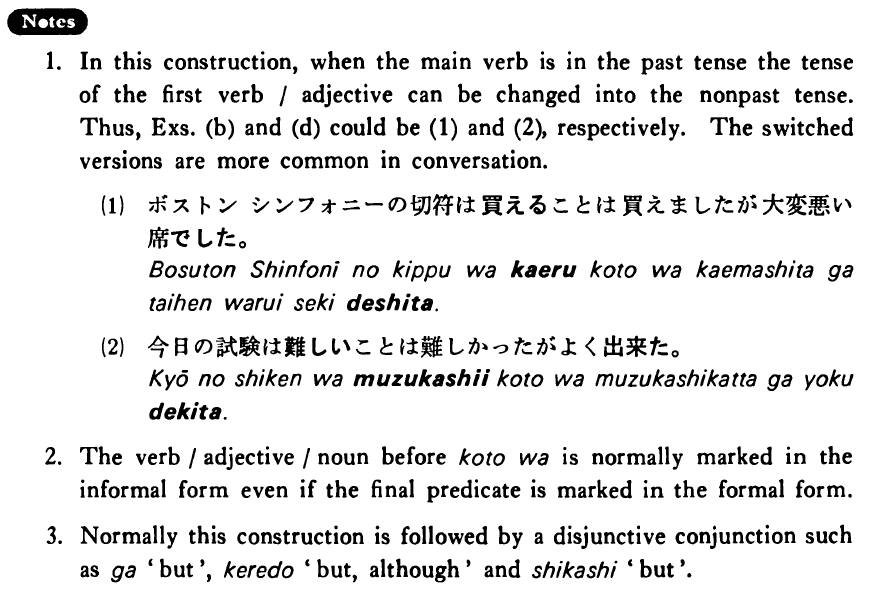
1. In this construction, when the main verb is in the past tense the tense of the first verb/adjective can be changed into the nonpast tense. Thus, Examples (b) and (d) could be (1) and (2), respectively. The switched versions are more common in conversation.
2. The verb/adjective/noun before ことは is normally marked in the informal form even if the final predicate is marked in the formal form.
3. Normally this construction is followed by a disjunctive conjunction such as が 'but', けれど 'but, although', and しかし 'but'.